Improving Local Bus Connectivity in Blaby: A Starting Point
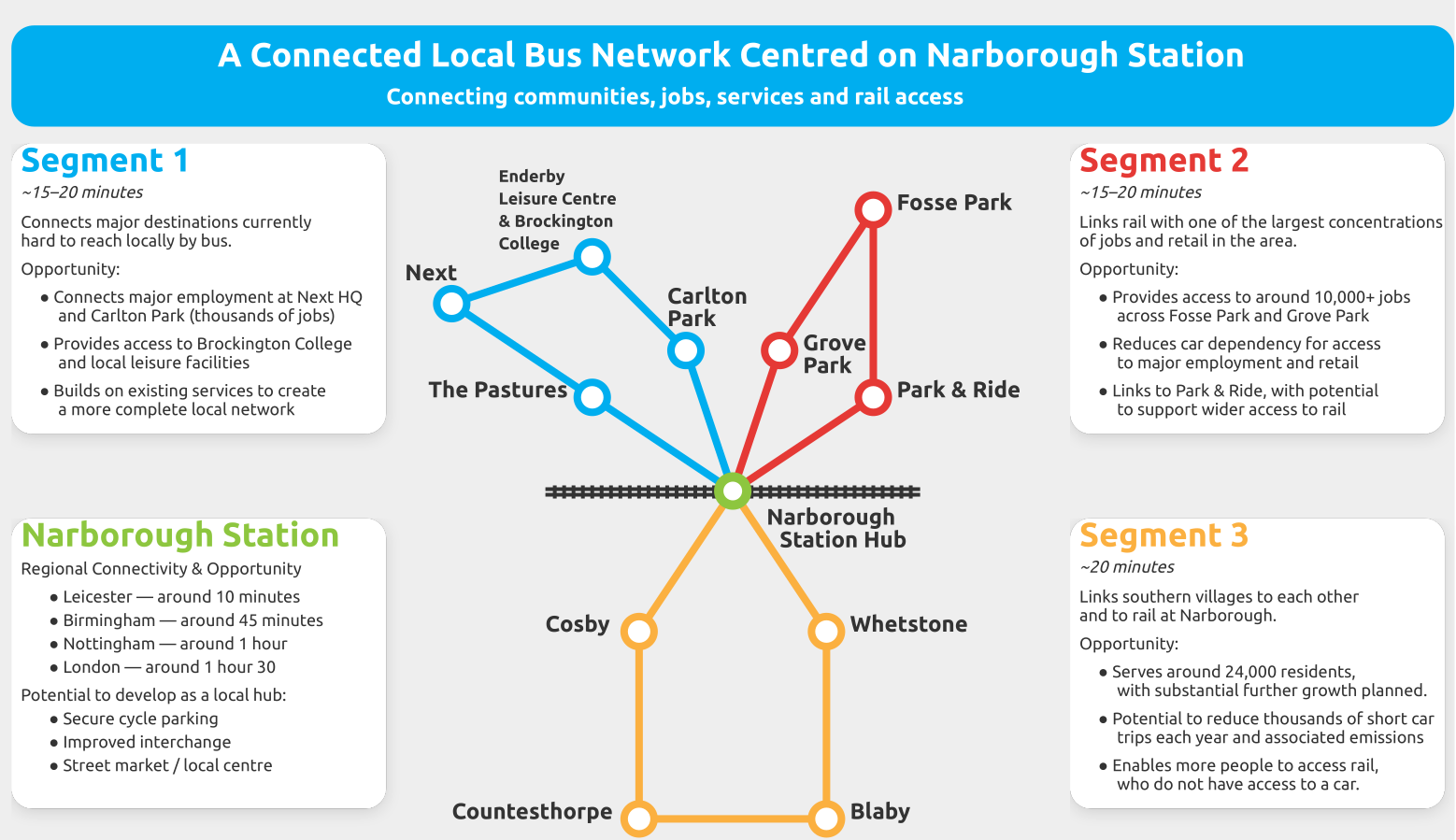
Following a recent discussion with Leicestershire County Council, we are beginning to explore how local bus connectivity in the Blaby area could be improved.
The focus is not on routes into Leicester, but on everyday journeys within the Blaby area itself — between villages, employment sites, services and Narborough Station.
The issue
At present, most bus services in the area are designed around corridors into Leicester. While these are important, they do not always support local journeys.
This creates gaps such as:
- Limited direct connections between nearby villages
- Difficult access to major employment sites
- Poor access to Narborough Station by bus
These are often short journeys, but many are currently made by car or taxi. In many cases, these are journeys that could realistically be made by public transport if suitable connections existed.

What this means in practice
From local observation and feedback, this leads to situations such as:
- Residents driving short distances to Narborough Station, adding parking pressure in nearby streets
- Workers travelling to major employers relying on taxis or lifts
- Journeys between nearby settlements requiring indirect routes
These are not unusual journeys — they are part of everyday life.
Demand already exists
Blaby is not a small or isolated area.
The villages and surrounding settlements represent a population of around 40,000 people, alongside major employment sites including:
- Next HQ
- Fosse Park and Grove Park
- Carlton Park
The issue is not a lack of demand, but a lack of connections between where people live, work and travel.
A possible approach
One way of addressing this could be to introduce a simple local network layer, focused on short, direct connections between key destinations:
- Connecting villages to each other
- Linking residential areas to employment sites
- Improving access to Narborough Station
This would not replace existing services, but complement them.

Important: early stage
This is still at an early stage.
Leicestershire County Council are looking to carry out further engagement to better understand local travel needs before any decisions are made.
Invitation for input
Local insight will be essential to shaping any future service.
If you live or work in the area:
- Where do you regularly travel that is difficult by bus?
- Which journeys would you make if a better service existed?
We’re not trying to create demand. The demand is already there. The challenge is to connect it.
Closing line
Improving local connectivity is not about creating new journeys. It is about better connecting the journeys people are already making every day.
Blaby. I’ve asked the council why fox connect prioritises fosse park from Narborough over our local shops in Blaby. The answer was that Blaby has a bus service and doesn’t need one from Narborough. The council are only interested in the big money from fosse park rents and not in our local community.
Whilst I think this is a good initiative I don’t see that it will ever be a practical solution for public transport.
The reasons are many. I could start by saying that this service already exists, it’s called Uber!!! I’m not trying to be facicious but Uber does exactly what you are suggesting. It connects all the journeys that are not easily covered by the existing public transport network. Let me provide two recent examples.
One: My vehicle had been dropped off at CG Cars, Narborough Road, near the Braunstone crossroads. I needed to pick it up. I live on the pastures. I walked to Copt Oak bus stop (no 50) and found that I had missed the bus by less than 5 minutes and next bus 60 minutes. Had I used the bus I would still have has a longish walk. Answer Uber. 5 minute wait and £4.69 and dropped off where I needed to be.
Two: I had dropped off my Community Action Minivan in Blaby (I am a Community Action Volunteer driver) and needed to get home. No practicable bus route. Answer Uber. 4 minute wait, £4.97 and dropped off at home.
On a larger scale my main criticism of public transport is the constant need to use not one but two busses to get to destination. In to Leicester, walk across Leicester, out to destination. Example: Pastures to Abbey Lane, Pumping Station. or car distributor. There is very little co-ordination between the different services, useful timetabling in formation is non existent particularly for the occasional user. Eg. timetable routing is primarily listed by route destination. I might know my destination is on Aylestone Road but there is no information to tell me which services run along Aylestone Road. I have to find and ask at an information window if it is manned.
Once upon a time public transport was regarded as a service. It is now a business that is driven by the need to make a profit. There you have the primary reason why it will never achieve what you are trying to. It is simply not flexible enough to cope with infinite journey choices at low cost. What it can do is cary many people on repeatable fixed journeys such as going to and from work in the City.
What I would like to see is a co-ordinated transport system such as having a ticket from journey source to journey destination but using any available options. Some time a train from Narborough will be more convenient than a bus but that means two tickets and I would want to make that decision at journey time not in advance.
Bust stands in Leicester are not co-ordinated in any manner that is apparent to me. It appears to be more related to availability of suitable locations where a group of busses does not upset the whims of the City Council and their inability to manage transport.
I recall the “Big Bus Plan” (I think) with its continuously update information LED boards but they only cover the City areas, here in Narborough there are none and the Ariva app is useless for getting real time bus information.
In your considerations you will need to find a better way to provide real time useful information on how your proposed service can be accessed by occasional users as well as regular users. In my opinion the current information provision is largely worthless and will need to be significantly updated or replaced.
Thanks Richard, that’s a really helpful and detailed perspective.
The examples you’ve given are exactly the kind of journeys we’re trying to understand, particularly where the current bus network doesn’t work well and people turn to alternatives like Uber.
The points around connections, frequency and especially information are really important. If public transport is going to be a realistic option, it needs to be simple to understand and flexible enough to work for more than just regular commuters.
This is very much an early-stage idea, so it’s useful to hear both where the current system falls short and where people are finding alternatives that work better.
Please could it be considered to include Croft within this, we are also Blaby District. Our bus links are poor with nothing on Sundays. Our lad has health issues so cannot drive so is really struggling to find a job due to relying on the bus service. Thank you in advance.
Thanks for your comment, Joseph.
You’re right to highlight Croft, and the point about Sunday services is particularly important. The impact on access to work really brings this into focus.
At this stage I’m trying to keep the initial proposal simple and deliverable, but I’m noting all of these areas as part of the wider picture, especially where limited bus services make it harder for people to access employment and everyday activities.
Pingback: When the Bus Doesn’t Turn Up - My blog
Pingback: On-Demand Buses: A Solution to the Wrong Problem? - My blog
Pingback: Why Is It Quicker to Walk to Narborough Station Than Take the Bus? - My blog
Pingback: From Narborough Station to Park & Ride: Updating the Local Bus Network Concept - My blog